
Military Aviation in San Antonio


By Robert Hupel

San Antonio, Texas has had a rich history and connection to the military from the Texas Revolution against Mexico and the Battle of the Alamo to the many military installations that are still present today. One of the major points that can be noted about the city is that it hosts many legendary military installations in establishing military aviation. The history of these bases is long and important, as they are still pertinent to today’s society as the bases have changed over the years with some fading away as others evolving with the needs of the ever-changing military, but their legacies are still relevant and are still present in San Antonio, as they still carry reminders of the legends who had at some point in their careers graced these bases with their presence.

The first military aircraft built by the Wright Brothers was first delivered to Fort Myer and fight tests began in August 1908. The first flight ended in disaster as the plane was crashed by Orville Wright, who was injured, and the accident killed the passenger, Thomas Selfridge. Midway through 1909, the military and Wright brothers proceeded with training of military personnel, which ended in the fall of 1909. They then moved the plane to Fort Sam Houston but were ordered to display it at the annual Chicago Electrical Trade Exhibition. The addition of the airplane was the initiation of a new military arm within the Army. Aviation would become a part of the Signal Corps of the Army and in time take on the title of the Aeronautical Division of the Signal Corps. The value of the aircraft would not be noticed until World War I, and even then, it faced an uphill challenge for recognition.

February 1910 was the start of military aviation in San Antonio, as Lieutenant Benjamin Foulois was assigned to Fort Sam Houston with the only aircraft that the Army begrudgingly acquired due to the insistence of President Theodore Roosevelt. In the early years at Fort Sam Houston, Foulois and his team experimented and tinkered with the aircraft created by the Wright brothers, which included exchanging the skids for wheels and removing need for a catapult system to launch the plane. They soon proved the plane’s worth, and the signal corps would gain $125,000 for Army aeronautics, which would be the start of the Army Air Corps. The acquisition of the funds and the approval from the President show examples of how early aviation took form as Benjamin Foulois on many occasions took his fight for funding and an aviation division to Congress in many cases bypassing the general staff who often had a poor opinion about aviation in the military. They also grew in numbers as some junior lieutenants joined their ranks, one of them being George E. M. Kelly, as plane builder Glen Curtiss offered free flying lessons at his school. The military would also gain other aircraft as they took in the Curtiss Type IV military pusher. In February 1911 George Kelly became the first fatality of powered flight in the military.

After the death of George Kelly, General William Cater of the Maneuver Division of Fort Sam Houston, ended all flying at the fort and sent the aviators and their aircraft away. They first moved back to College Park, Maryland where they learned to fly, and then due to the cold winters there, they were moved to Augusta, Georgia. When the Army needed the to help with the conditions on the Texas Mexico border, so the unit was sent to Texas City, Texas. They then moved to North Island, California and set up a flight school there. After that, they were sent to Fort Sill, Oklahoma. Fort Sill was used as a place to practice coordinating observation with artillery.

They do return to San Antonio Texas, in November, the 1st Aero Squadron flew from Fort Sill, Oklahoma back to Fort Sam Houston in San Antonio, Texas. Not long after they arrived, Pancho Villa started to raid into New Mexico, and the unit was sent to Columbus, New Mexico. They then served in multiple areas in New Mexico before returning to Texas and Fort Sam Houston. Later in 1916 would be the start of Kelly Field. In November 1916, a now Major Foulois returned to San Antonio to find a suitable site for a new flying field, which he found and on November 21, 1916 began the negotiations to set up the first flying field which would start in January 1917.On April 5, 1917, four JN-4 Jennies landed on the newly formed field that was still under construction, and on the following day the United States entered World War I. The next few weeks, 4,400 recruits came to the field, and it quickly took shape as wooden structures sprung up to accommodate the troops, and the field was named Camp Kelly in honor of Lieutenant George Kelly who had perished while flying a military aircraft. It became a tradition to name many of the airfields after pilots who died in crashes.

The plans were that they would set up six Kelly Fields, but Kelly Field Number Five soon became Brooks Field in February of 1918. Kelly Field Number Two was turned over to Air Services on October 1, 1917, and could hold five-hundred students, seventy-five instructors and two-hundred aircraft, while Kelly Field One served to maintain and service the aircraft as well as the home of the reception and training center. The Army Aviation Division was still new in many cases and there were some challenges that had to be rectified, as noted in Claire Chennault’s memoirs. He pointed out that at one point he felt like he needed a vacation, and “borrowed a “Jenny” (the name of the type of aircraft that they used). He flew up to Dallas from San Antonio and took a week off. He was absent without leave (AWOL) at this time, but he noted that no one had missed him or the aircraft. He also talked about a mechanic who wanted to fly and decided to take one of the Jennies for a flight from Kelly field but crashed it into the water tower at Kelly. The Army wanted to Court Martial the mechanic but could not because the Army had not created regulations on who could fly the aircraft and who could not at the time, though that was corrected soon after that incident. Flight training was one of the main roles of Kelly Field from 1917 and continued until mid-World War II. In 1943, Kelly One and Two united and moved solely into the role of repairing and modifying aircraft. Kelly Field would continue in this role until it closed in July of 2001 where a portion of the base was returned to the City of San Antonio and the other parts assigned to Lackland Air Force Base. In its time in service Kelly Field had seen many pilots grace their field to include Captain Carl Spatz, who was one of the four pilots who first landed their Jennies on the unfinished Kelly Field, as well as Charles Lindbergh, who also trained under Claire Chennault at Brooks Field.

One of the pilots who learned to fly at Kelly Field was a native of San Antonio, twenty-two-year-old Sidney Brooks. Brooks died in a training accident on Kelly Field on November 13, 1917, when his Jenny crashed. The San Antonio Chamber of Commerce requested that the new aviation field be named after Brooks, though it was initially named Kelly Field Number Five. It was later renamed to Brooks Field, which would be the start of an airfield that would always be in a state of change as it evolved into many different roles and obligations for the military and the United States Armed Forces. Ground was broken on December 8, 1917, and the base was formally named Brooks Field on February 4, 1918. Brooks Field was started in December 1917 to increase the number of training facilities to train pilots. The need for another field was to take the load off Kelly Field #1 and #2. Brooks Field, over its timespan, took on many different roles to fulfill the needs of the military and had a host of individuals who would train and be trained in aviation. The first role of Brooks Field was to be a flight training school, as it would take some of the load from Kelly Field.
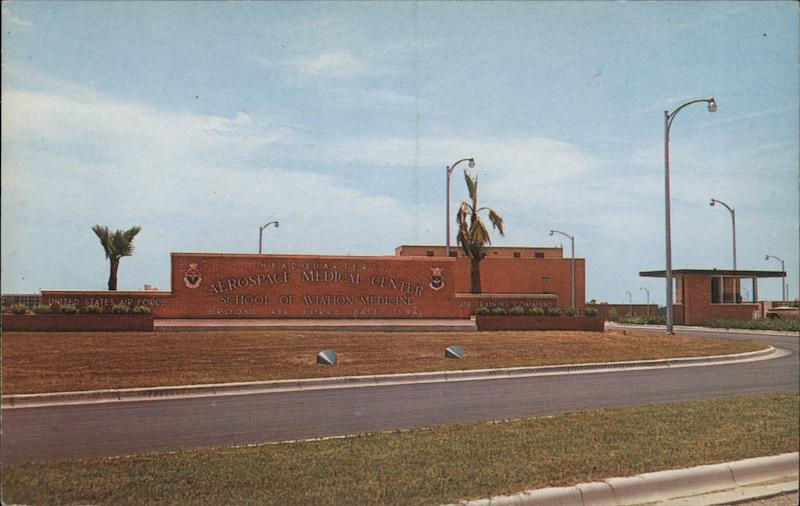
Brooks Field would serve many different roles and bring in many new innovations to flight, aeronautics and medicine. They started off teaching the Gosport Training System which helped to reduce the number of training death that occurred while flying. It was a simple introduction of a tube which allowed the trainer to give instructions to the trainee as well as a second set of controls which the instructor could engage and take over the aircraft if needed. Brooks Field and William Ocker, an instructor there were the driving factors for instrument fight, through the Ocker box which pilots used to orient themselves when they could not see the ground or landmarks. Brooks Field was also the birthplace for paratrooping which Master Sergeant Erwin Nichols, with Benjamin Chidlaw and Claire Chennault played a part in its introduction. Brooks Field would also see such pilots such as General James “Jimmy” Doolittle who led the mission to bomb Tokyo. He would lead a bunch of B-25 Mitchell bomber that launched from the USS. Hornet a feat that was believed to be impossible. Three future Chiefs of Staff for the Air Force, General Thomas White, Nathan Twinning, and Curtis LeMay would come from Brooks Field. Brooks Field also took on the role of being the Primary Flight School for the Army Air Corps, before Randolph Field opened in 1935 and Primary Flight Training moved there. Brook Field also hosted Aviation Medicine in 1917 but would lose it to Randolph as well before it returned in 1957, which became Brooks Air Force Base’s primary mission in the Air Force. Aviation Medicine with all its components from Aerovac Medicine to Space Medicine. Brooks oversaw Aviation Medicine as its primary mission until Brooks was closed in 2011.

Randolph Air Force Base was conceived in 1927 and named after Captain William Randolph who died in a plane crash in 1928. The base would be formally dedicated in 1930, and in time it would be known as the Showplace of the Air Force. The base served as the starting place for many pilots, as they would receive their Primary Flight Training there. Randolph Field, as it was originally called, was named after Captain William Randolph, a native of Austin, Texas, who was in the Army Air Corps and who had died in an airplane accident in 1928, though the initial plans for the airfield were first put to a board on April 18, 1927, and the findings needed to reach the headquarters by no later than May 1, 1927. The board consisted of the following individuals: Capt. C. B. Oldfield, A.C. Brooks Field, Capt. R. Beam, A.C. Duncan Field, A.C.T.C., Capt. W. E. Lynd, A.C. Kelly Field, Capt. W. S. Wright, A.C. Kelly Field, 1st Lt. W. H. Brookley, and A.C. Brooks Field, by command of Brigadier General Lahm who was known as the “Father of Randolph Field”. The plans for a new field gained the attention of Lieutenant Harold Clark who was at the dispatch officer for the motor pool at Kelly Field. The lieutenant had been trained as an architect and he drew up the plans for an idea of his called “Air City,” which would become Randolph Field, which was the second largest project untaken by the U.S. Army Corps of Engineers, dwarfed only by the first which was the Panama Canal. After seeing the designs General Lahm had Lieutenant Clark temporarily assigned to him to design Randolph Field to include the innovative work of the Taj Mahal. Randolph has been referred to as the West Point of the Air Corps. Basic Flying School, and later, when the Air Force split away from the Army, it was noted as the showplace of the Air Force due to the Spanish Colonial Revival Style architecture, and one of the most notable structures is the Command Center, which is tall tower topped with a dome called the Taj Mahal, or just Taj. When the Taj was first constructed, it was the most forward-thinking military structure of the day. The airfield started off as an Army Air Corps Primary Flying School from 1931-1939. Their mission changed in 1939 to being a basic flying school which lasted till 1943, in which it became the Central Instructors School. Randolph Air Force Base has continued with its mission of flight training for the Air Force as well as for their allies who wish to train there.

The base has trained many of the pilots who took part in World War II and later conflicts. One of the pilots who was trained there was Richard Cole who became Jimmy Doolittle’s copilot as part of Doolittle’s Raid. Cole later flew supplies into China over the flying over the “Hump” as part of the Burma Airlift, where United States pilots flew supplies and troops over the Himalayan Mountains, some of the highest points on earth, into China. On April 9, 2019, Lt. Col. Richard Cole, the last of the Doolittle Raiders and Jimmy Doolittle’s copilot, passed away. The memorial ceremony was held on April 18, 2019, on the 77th anniversary of their famous raid. The ceremony was held at Randolph Air Force Base where he had started his career in flight back in February 1941, just over a year before he would be a part of history as he and General James Doolittle would bomb Tokyo.

The last Air Force Base of note within San Antonio is Lackland Air Force Base. Lackland is the youngest of all the bases in San Antonio. Originally Lackland was part of Kelly Field, and on the area of land that had been used as a bivouac area as well as a bombing range for the advance aviation cadets. In 1941, as the need for aircrews increased and its mission changed, the area was named and designated as the Air Corps Replacement Center, before it became the San Antonio Aviation Cadet Center. This change occurred when a recruit training detachment from Kelly Field came to the area. The base then took on the name of the newest tasks that were placed upon it as it was renamed and tasked as the San Antonio District Army Air Force Personnel Distribution Command at the end of the war in 1945. It quickly took on the role of the Army Air Force Military Training Center, as well as the Indoctrination Division, Air Training Command in 1946. Lackland maintains those roles today. It was not until 1947 that the base was named after Brigadier General Frank D. Lackland, the man who had been the commander of Kelly Field and came up with the idea of the aviation cadet training and reception center which now bears his name.

Over the years San Antonio has been a part of the military aviation and continues to support it and its troops. Although some of the bases have changed in their roles and missions, they are still a part of the rich military history that is San Antonio Texas. In traveling through the city and through the bases that have reverted to the city, the presence of the Air Force can be seen in the static displays, monuments, and streets that run through the city bases. The military and the Air Force will always be a part of this city.

Resources:
Charles Lindbergh: Biography, Trailblazing pilot, baby kidnapping. Accessed September 27, 2025. https://www.biography.com/history-culture/charles-lindbergh.
Chennault, Claire Lee. Way of a Fighter; The Memoirs of Claire Lee Chennault; ed. by Robert Hotz. New York, New York: Putnam, 1949.
Finney, Robert T. History of the Air Corps Tactical School, 1920-1940. Maxwell Air Force Base: USAF Historical Division, Research Studies Institute, Air University, 1955.
“General Curtis Emerson Lemay.” Air Force. Accessed September 26, 2025. https://www.af.mil/About-Us/Biographies/Display/Article/106462/general-curtis-emerson-lemay/.
“Major General Claire Lee Chennault.” Air Force. Accessed September 26, 2025. https://www.af.mil/About-Us/Biographies/Display/Article/107526/major-general-claire-lee-chennault/.
Nunneley, Sarah A., and James T. Webb. “Aerospace Medicine at Brooks AFB, TX: Hail and Farewell.” Aviation, Space, and Environmental Medicine 82, no. 5 (May 1, 2011): 567–70. https://doi.org/10.3357/asem.2912.2011.
Okerstrom, Dennis R. Dick Cole’s War: Doolittle Raider, Hump Pilot, Air Commando. Columbia, MO: University of Missouri Press, 2015.
Parrish, Pat, ed. A History of Military Aviation in San Antonio. San Antonio: United States Air Force Publications, 2010.
Schrader, Karl R. “A Giant in The Shadows: Major General Benjamin Foulois and the Rise of the Army Air Service in World War I.” A Giant in the Shadows: Major General Benjamin Foulois and the Rise of the Army Air Service in World War I. Thesis, School of Advanced Air and Space Studies, 2010.
“Sgt William Ocker.” National Museum of the United States Air ForceTM. Accessed September 26, 2025. https://www.nationalmuseum.af.mil/Visit/Museum-Exhibits/Fact-Sheets/Display/Article/3256635/sgt-william-ocker/.
Witcher, T.R. “Pioneers and Parachutes: Brooks Air Force Base Old Hangar 9.” Civil Engineering Magazine 90, no. 2 (February 2020): 44–47. https://doi.org/10.1061/ciegag.0001461.


Comments